Pasta with Bishop Barron
20 Aug 2026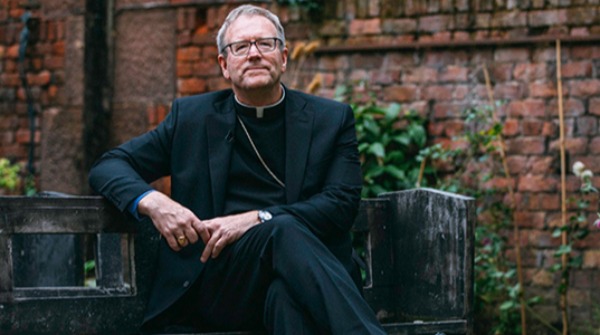
Throughout July, as Star of the Sea parishioners we were invited to join Fr Matt Restall at St Pius Church every Tuesday after Mass for Pasta with Bishop Barron.
A small group of us gathered in the foyer of St Pius X, in West Warrnambool, to enjoy the food and a cuppa prior to sitting down to watch a session with Bishop Barron.
Bishop Robert Barron originated from Chicago, Illinois USA and is now the Bishop of the Diocese of Winona-Rochester in Minnesota, United States. He is well known for his Media Ministry: Founder of the global Word on Fire.
Bishop Barron explores the profound meaning of the liturgy as the "source and summit of Christian life" in The Mass. Throughout the videos we viewed, Bishop Barron can be seen speaking from lecterns in various Catholic Churches along his travels, discussing liturgy as being “an intimate, active encounter with Christ”. One of the many Churches he spoke from was Notre Dame, Paris, and a favourite, Orvieto Cathedral, Italy. Bishop Barron speaks so brilliantly that he was able to capture our attention for over 1hour each time on the meaning of Mass, The Holy Spirit, Hell, Heaven & Purgatory and the Church. Here are some excerpts taken from the sessions “-
The order pertaining to the Mass as outline below and as described by Bishop Barron is where Heaven & Earth embrace. Bishop Barron describes it as a Call and Response: A dynamic dialogue between Christ (acting through the priest) and His mystical body, the Church.
· The Gathering – the act of gathering is in itself a mystery
· The call out from the Greek word ‘ecclesia’ into the Church
· Introductory Rite – The Sign of the Cross. To claim your identity as belonging to the Trinitarian God – The Triune is The Father, The Son & The Holy Spirit
· The Priest wearing of vestments demonstrates that it is not about the Priests personality. Bishop Barron notes that the priest is in persona Christi and says the Mass without inserting himself, personally, into it
· Acknowledge our sins – Lord have Mercy
· Glory to God in the Highest – supreme form of worship
· The Liturgy – The first Reading of The Old Testament links us and helps us to understand the New Testament
· Responsorial Psalm – responding to The Word that we just heard
· Second Reading – The Apostolic Word of the New Testament
· The Gospel – is The Word in person speaking – a moment of solemnity
· Then the Homily provides a bridge between The Gospel and our daily lives
· Allelulia is our response to The Word (when singing together it becomes harmony)
· The Creed is a summary of the bible – Stand Up and I believe is a declaration of our faith
· Prayers of the Faithful – opportunity for a confident request
· The Offering – Bread, Wine and Money (our act of making a sacrifice)
· The Eucharistic Meal - Eucharist: Sacred Meal, Sacrifice, Real Presence. His Word was made flesh. The Incarnation – the real presence of The Lord, the consecration of the Bread and Wine
· This is My Body and This is The Chalice of My Blood. The real presence by the power of God’s own words. God’s word is creative – transubstantiated, transfigured. God’s word is. Jesus’ is the word made flesh. What Jesus’ says is
· It’s the moment the Son is offered to The Father. God does not need anything ‘ex nihile’ but we instead become fed
· We become ordered again because of The Mass
· And Finally - Go in Peace The Mass has Ended – to bring the light, bring The Christ – We are sent out like disciples and Bishop Barron says we are “Christofied”
Bishop Barron goes on to discuss the Holy Spirit by using the North Rose Window in Notre Dame, as a symbol. He goes on to explain the meaning of the stain glass window and “repeating patterns in eights, symbolises eternity, geometric harmony, beatific vision and rays of sunlight act as architectural foretaste of heaven. It teaches us that only with the illumination of God’s Word and life from outside us, can our humanity radiate with splendour, goodness and beauty”. By being drawn into the light we also see our sins and blemishes. It can signify us going towards the light of grace. Bishop Barron states that our Holy Spirit contains our body and the seven gifts of Holy Spirit when confirmed :-
1. Wisdom (from the standpoint of God)
2. Understanding
3. Right Judgement
4. Fortitude & Courage
5. Knowledge
6. Piety – pious
7. Fear of the Lord
There was more said about Purgatory as a Purification rather than about Heaven and Hell. Purgatory as being the Ascetical Principle.
On the shores off northwest Ireland, in the county of Donegal otherwise known as St Patrick’s Purgatory, people were being ferried to this island in the middle of the lake. The weather was wet and cold, and windy. People were clad in raincoats and jackets but walking in bare feet. Most of them carried rosary beads in their hands, and some of them were praying aloud and a few were on their knees climbing over stoney outcrops.
Those who went to Lough Derg took their spiritual lives seriously, were willing to endure hardship in order to deepen their communion with God, obtain a full friendship with God and seek self-discipline. According to Bishop Barron, John Henry Newman commented that Christians understand that our sinful nature has to be chastised, disciplined, and rightly ordered. When the ascetical instinct disappears (as it has in much of Western Christianity), the spiritual life rapidly becomes superficial and attenuated, devolving into an easy “I’m okay and you’re okay” attitude.
After each session we participated in a very relaxed follow up format called SOAP which enabled us to reflect and to conclude:-
S – What strikes or speaks to you
O- Observations
A – Application
P- Prayer